


In the inadequate realities of real estate prices in Moldova, and especially in Chișinău, our company offers uniquely advantageous options for fulfilling your dream of owning your own home.
Only with us can you purchase a house even with a modest budget, while still receiving maximum quality of workmanship and materials.
When building a custom home, there are no design limitations for you. You express your vision, and our team, with more than twenty years of experience in house construction, will make every effort to bring it to life.
Contact us and discover the world of affordable real estate!
Construction technologies
Roof structure
The roof is a strategically important element in the construction of any building. If it is installed improperly, the consequences can turn out to be extremely costly. Fortunately, our company is well trained and has considerable experience in the installation of all types of roofs. Single-pitch, gable, hip, multi-gable, and many others, with coverings made of various types of materials!
With us, there are no limits!
Below we present, as examples, two of the most common roof options in Moldova, in terms of price and durability. However, these are only examples, and in custom construction we make any changes that comply with technological standards.
Roof "Base"

This type of roof has its advantages. The main one is the possibility of creating a visually flat roof, although in fact it has a slope for water drainage. The design of a flat roof is especially valued in a strict architectural style, as well as the use of more affordable materials compared to classic roofs.
Service life: 10+ years
Roof "Classic"
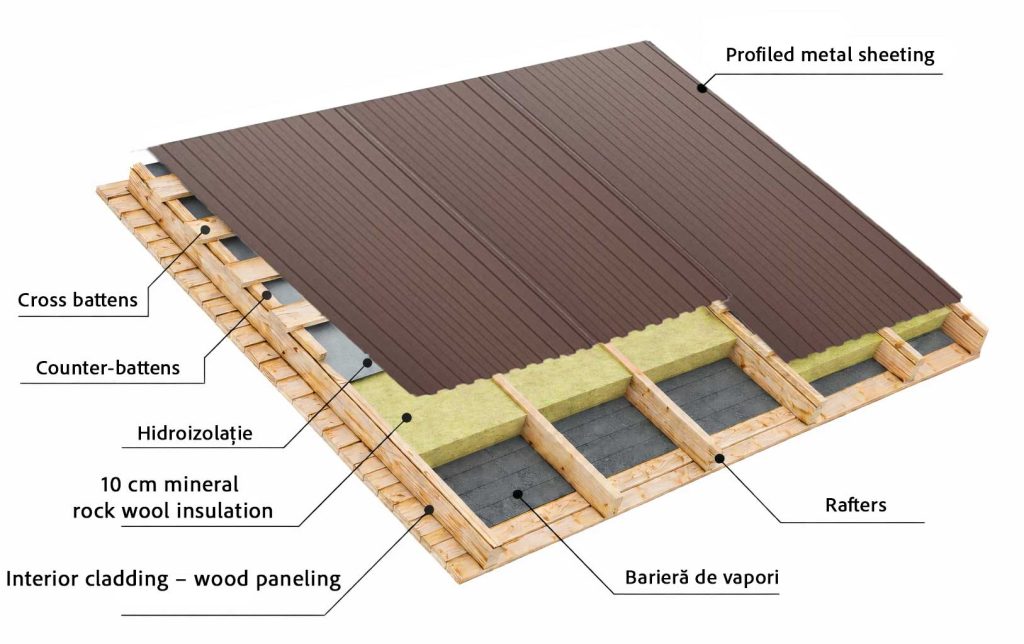
The Classic-type roof is the most popular in Moldova, mainly due to its durability, practicality, and, of course, reliability. Although perhaps its only drawback is increased noise during rain, especially hail.
Service life: 10+ years
Wall construction
The advantages of modular house walls include high construction speed (quick assembly and readiness for occupancy), factory quality (manufactured under controlled conditions), energy efficiency (excellent thermal and sound insulation due to modern materials and sealed joints), cost savings (thanks to a lightweight foundation and reduced labor), as well as eco-friendliness and mobility (ease of transportation, possibility of relocation). They allow the construction of houses without long settling periods, regardless of the season, and enable the use of lightweight types of foundations.
Wall "Base"

Base is good due to the simplicity and affordability of the materials used. The walls are insulated with foam, which provides excellent thermal and sound insulation, low cost, ease of installation, moisture resistance, and durability. Foam effectively reduces heat loss, keeps interiors cool in summer, lowers heating and air conditioning expenses, and, thanks to its light weight, does not overload the foundation, making transportation and installation in frame and modular constructions easier.
Service life: 10+ years
Wall "Classic"

The main advantage of "Classic" walls is that both the exterior and interior finishes are indistinguishable from those of traditional residential houses. From the outside, the house looks completely ordinary, with no hint of modular construction. Insulation made of mineral wool (mineral fibers) offers numerous benefits: excellent thermal and sound insulation, high fire resistance, and vapor permeability (“breathable” walls), creating a healthy indoor climate, as well as being eco-friendly, durable (up to 50 years), and resistant to rodents and chemicals. This significantly reduces heating and air conditioning costs, ensuring year-round comfort, while maintaining a relatively low structure weight and allowing for quick installation.
Service life: 30+ years
Foundation construction
Despite the simplified construction technology, a foundation for a modular house is a mandatory requirement. The correct choice of foundation type directly affects the durability of the building. Critical mistakes at this stage can cause the house to shift, leading to damage on the roof. There is a particular risk when construction is carried out on unstable soils. To make the right choice among the recommended foundations for a modular house, attention should be paid to the following criteria:
1. The type of soil on which the house is being built – for weak silty, peat, clay, clay-sand, or sandy soils, different types of foundations are selected according to their characteristics;
2. The weight of the future house – the lighter the structure (consisting of fewer modular blocks), the simpler the foundation that can be used;
3. Climatic conditions – it is better to choose a maximally reinforced foundation if the building is being constructed in areas prone to frequent flooding, heavy rains, landslides, and other adverse climatic factors.
Pile foundation
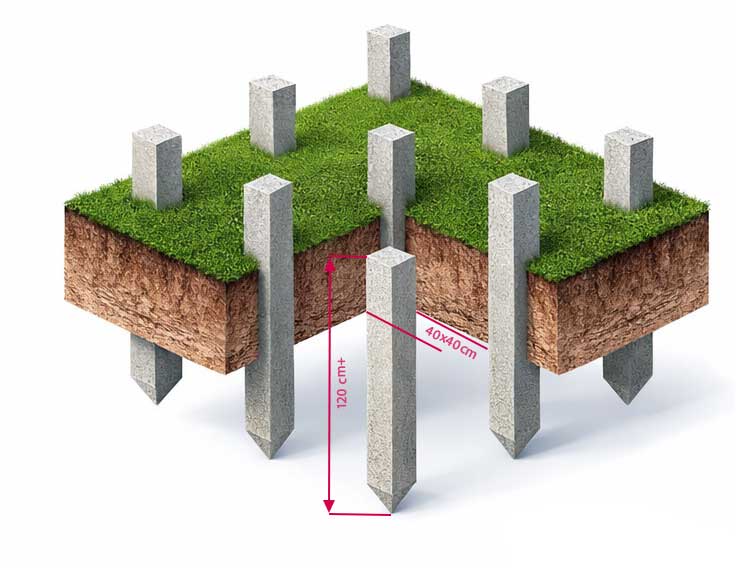
Pile foundations for modular buildings can be either reinforced concrete or screw piles. When using this type of foundation, the following advantages can be utilized:
1. Durability. The deep embedding of piles into the ground allows them to withstand significant loads, ensuring long-term performance of multi-story modular structures.
2. Stability. The wear-resistant structure can withstand adverse weather conditions, mechanical impacts, and other loads.
3. Versatility. A reinforced concrete pile foundation can be easily constructed even on marshy areas with shallow groundwater levels.
Service life: 20+ years
Strip foundation
